Mostek’s position
Mostek maintains that she reasonably shot Aggie to protect her own dog, Buddy, while the dogs and Maynard were on the pavement at her feet.
Justice for Aggie
Competing accounts, recordings, deposition testimony, and scene evidence concerning April 21, 2024.
Read the analysis of Aggie’s breed and Mostek’s justification →
Mostek maintains that she reasonably shot Aggie to protect her own dog, Buddy, while the dogs and Maynard were on the pavement at her feet.
Kent Maynard recalls lying helpless on the ground, holding Aggie against his chest, when Mostek fired. In his account, the bullet entered Aggie’s left ear just inches from his face.
He contends that he had restrained Aggie and that Buddy had begun moving away before the shot. He describes the shooting as a danger to his own life as well as the loss of his dog.
Disputed claims: These competing characterizations remain disputed in pending litigation and are not findings by this site.
In Kent Maynard’s account, he was on the pavement holding Aggie against his chest when Mostek fired. The shot killed Aggie and came within about an inch of striking him in the face. In that instant, he lost a companion he depended on for emotional support and faced a threat to his own life.
In a survey of 4,902 bereaved pet owners, unexpected deaths were associated with more severe grief, depression, anxiety or insomnia, and difficulty functioning socially. That study examined unexpected pet loss broadly. It did not measure the combined effects of losing a pet to gunfire while nearly being shot oneself. Kogan et al., Journal of the American Veterinary Medical Association (2026).
Research on trauma in adults identifies perceived danger to one’s life and prior mental health difficulties as risk factors for post-traumatic stress symptoms. A life-threatening event can bring on new symptoms or worsen difficulties a person was already experiencing. The studies describe patterns across groups. Whether symptoms began or worsened after this shooting, and what contributed to any change, requires an individual assessment. Ozer et al., Psychological Bulletin (2003) and Brewin et al., Journal of Consulting and Clinical Psychology (2000).
Evidence, not breed stereotypes
No—not because of breed alone. Calling a dog a “pit bull” does not establish that shooting her was necessary. The question is what danger the dog actually presented and whether the use of force was reasonably justified when it occurred.2
The court’s February 9, 2026 opinion describes Aggie as a pitbull terrier mix. That is more accurate than treating her as a documented purebred. But the argument does not turn on a pedigree distinction: a purebred dog is not automatically dangerous, and a mixed-breed dog is not automatically harmless.1, 4
The American Veterinary Medical Association rejects predicting an individual dog’s aggressiveness solely from breed or labeling entire breeds dangerous. The ASPCA likewise emphasizes individual behavior, genetics, experience, and environment.4, 5
That is not a claim that every dog is safe or that genetics has no effect. The ASPCA acknowledges that some pit-bull lines were selected for fighting other dogs. The point is narrower: a breed stereotype cannot establish what this dog was doing, or what force was necessary, in this encounter.5
In her publicly released Tactical Response Report, Mostek identified Aggie as a pit bull while expressly acknowledging uncertainty about whether she was a mixed breed. She alleged that Aggie was biting and mauling Buddy near his neck and that she fired to save Buddy and protect herself. Her stated justification therefore included alleged conduct—not simply a breed label.3
Those assertions must be tested against the evidence. An account does not become independently verified merely because it is repeated in a police report, a news story, or an online comment.
Even if Mostek genuinely believed she had to fire to protect Buddy, that belief could not justify putting Maynard’s life at risk. Maynard recalls holding Aggie against his chest as he lay on the pavement and says the bullet came within about an inch of striking him in the face. On Maynard’s account, firing that shot to protect Buddy exposed a person to a potentially fatal head wound.
The Seventh Circuit’s rule requires an immediate danger and unavoidable force to justify killing a household pet. It does not authorize shooting a dog merely because someone fears its breed.2
Was Aggie restrained? What danger remained? Was shooting avoidable? These questions cannot be answered by a breed label. In February 2026, the court declined to resolve the disputed shooting facts in Mostek’s favor at summary judgment. That ruling preserved claims for further proceedings; it did not decide liability.1
Evidence of an earlier bite can matter. But it is not a substitute for examining the danger when the trigger was pulled. Conversely, the absence of an obvious injury would not, by itself, prove that no danger existed. The argument is not that someone must suffer an injury before taking protective action. It is that force must respond to a reasonably perceived, immediate danger—not punish an earlier encounter or a breed.2
In an April 22, 2024 Reddit discussion in the anti-pit-bull community r/BanPitBulls, one commenter called the shooting “public service.” Later comments debated whether the video showed a continuing threat. This is an example of public reaction in one forum, not a representative survey or proof that the commenters witnessed the encounter.6
Aggie’s breed was not a license to shoot her. The justification must come from the circumstances—not the stereotype.
This is editorial analysis of the identified public sources, not a finding of liability. The parties dispute material facts. The February 2026 ruling is described as a dated procedural decision, not as a statement that the case has reached a final judgment.
Plaintiff’s filed allegations
This is a summary of allegations in a filed pleading—not findings by the court. Defendants disputed liability, and later rulings resolved some counts.
The complaint alleges that Mostek fired toward Maynard while he was on the ground with Aggie, killing Aggie, placing Maynard in fear of being shot, and violating federal and state law.
It alleges that Mostek acted under color of law and within the scope of her employment, and that the City bears responsibility under the pleaded theories. Those allegations were contested.
It alleges that, after the shooting, Mostek made false statements to Maynard’s landlord describing Aggie as dangerous or vicious and allowed to run “amok,” intending to cause the landlord to terminate Maynard’s tenancy. The defamation count was later resolved against Maynard on summary judgment.
Counts II and III were dismissed at the pleading stage. Summary judgment was later entered on Counts IV and VI; the other counts addressed in the February 9, 2026 ruling remained unresolved at that stage.
When police shoot at a dog, human safety is also at stake →
CPD’s duty to reassess: the person holding the dog and the ability to stop a shot →
Read the court’s account and video limitations in the February 9 opinion ↗
Early CBS and ABC7 reports repeated an account attributed to police: that Aggie attacked Buddy and Mostek fired to stop the attack, without mentioning plaintiff’s contention that Aggie was in his arms when the shot was fired. The surveillance video was not yet public.
Sensitive content advisory: The linked videos show the fatal shooting of a dog and may be disturbing.COPA publicly released surveillance video 1 and surveillance video 2, along with other materials, through its official case portal. The footage supplied information that was absent from the initial reports and prompted new scrutiny of the official account.
Official incident reports, original recordings, and early news accounts →
Camera footage and 911 audio
Compiled by Kent Maynard from his Blink camera, the two surveillance recordings and Mostek’s 911 call released by COPA, and aftermath photographs taken by Maynard. Mostek’s call is included in this compilation and is available on COPA’s website as “911 Call 1”, the first of the five listed 911 calls. The two COPA-released surveillance recordings are also listed and linked on this site: Original surveillance video 1 and Original surveillance video 2 (graphic content).
This video depicts the fatal shooting of a dog and includes close-up photographs of Aggie’s body with substantial visible blood. It also contains distressing audio and strong language. Some viewers may find it deeply upsetting.
Timing disclosure: The 911 audio is aligned approximately with the camera footage, using Mostek’s testimony that she called immediately after entering her garage. The alignment is an editorial reconstruction, not independently verified synchronization.
Sources and editing: The Blink view shows Maynard’s porch. The surveillance views show the street, with the second view appearing as a lower inset. Audio of Mostek's 911 call is superimposed on the surveillance video and audio and should not be assumed to originate from the surveillance videos. The aftermath photographs are labeled separately and do not depict the exact moment of the accompanying call. The closing Blink footage of Maynard returning to his apartment has been replaced with a neutral card because its timing relative to the call is not established. The complete soundtrack and running time are retained. Embedded subtitles remain in the retained footage; the closing audio-only portion has no subtitles. New labels sit outside the original picture.
Subtitle note: Captions were supplied within the compilation and have not been independently verified against the original recordings. They remain embedded in the picture. The original recordings should be consulted when wording or speaker attribution is uncertain.
This is a plaintiff-prepared compilation, not a single continuous camera recording or a judicial finding. The circumstances and justification for the shooting remain disputed.
Original surveillance video 1 · Original surveillance video 2 · Mostek’s 911 call — COPA “911 Call 1” (external links; graphic content).
Deposition testimony
Deposition excerpt · April 3, 2025. Mostek answers questions while reviewing surveillance footage of the April 21, 2024 incident.
Graphic content: This video includes footage of the fatal shooting of a dog. Viewer discretion advised.
The excerpt contains on-screen subtitles. Questions and statements by the questioner are distinct from the witness’s answers. Mostek estimates the distance as “about four feet” and discusses limitations of the video’s viewpoint and quality. She did not answer the final assertion that Maynard was closer; that silence is not presented as agreement. A brief freeze-frame and fade to black have been added after the excerpt.
For a clearer view of the incident, see the original surveillance footage at COPA’s linked host: Surveillance video 1 ↗ · Surveillance video 2 ↗. These links also contain graphic content.
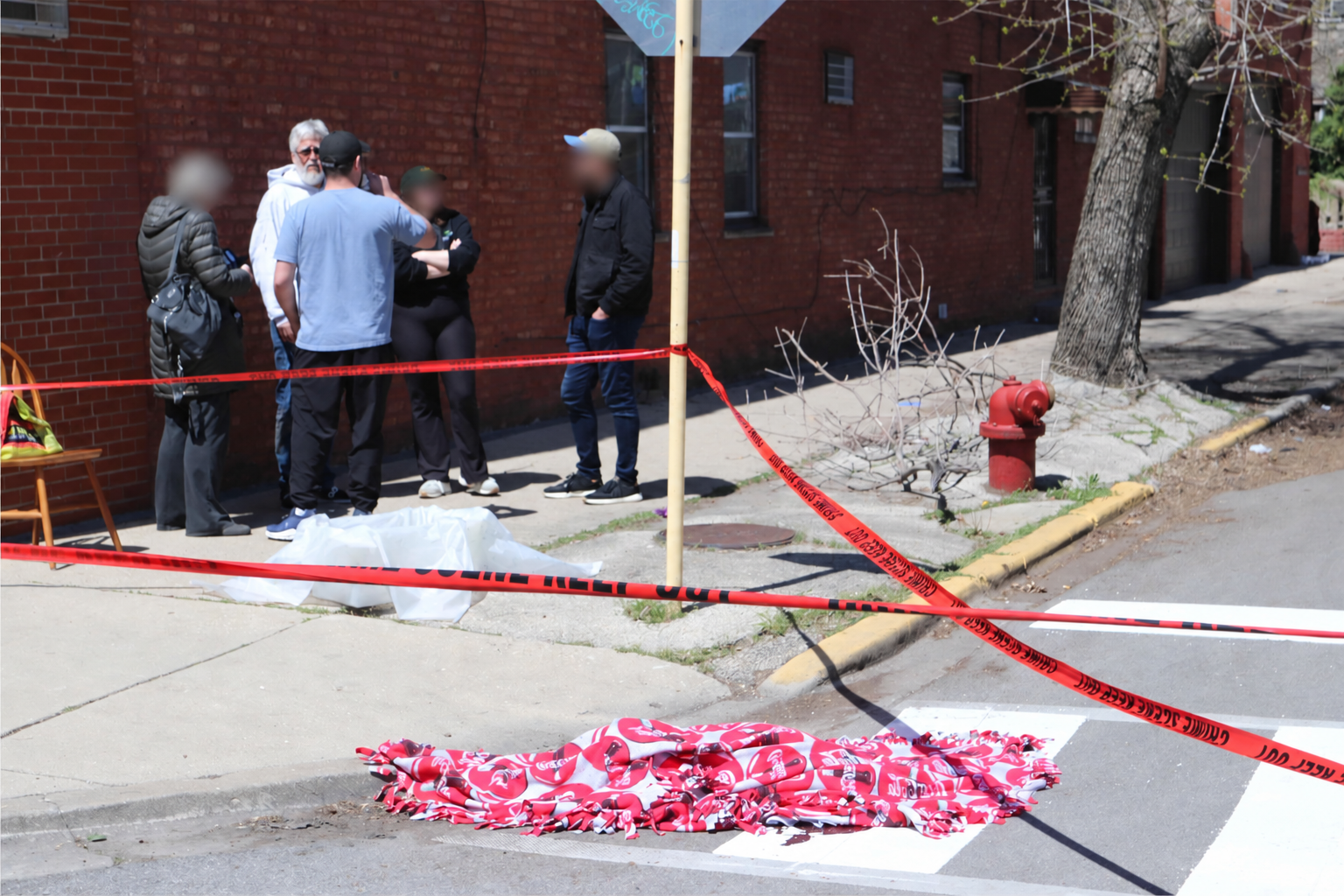
City-produced photograph
This photograph was produced by the City in discovery. It is presented for scene context and is not a judicial finding. Viewer discretion advised.